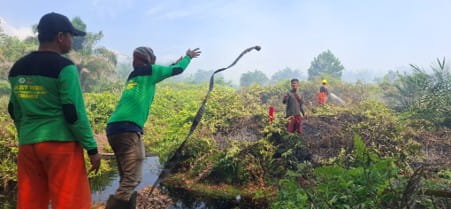
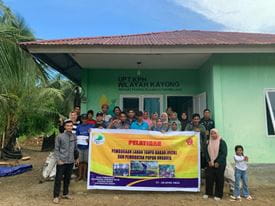
In response to ongoing forest fires in Indonesia, Bunge recently made a contribution to help protect communities, wildlife and habitats. The donation was directed to the Gunung Palung Orangutan Conservation Program (GPOCP) and its local partner, Yayasan Palung (YP), whose teams are at the forefront of conservation and emergency response efforts in West Kalimantan, Indonesia.
The forests in and around Gunung Palung National Park are among the most important habitats in Borneo, supporting an estimated 2,500 Bornean orangutans and a rich diversity of wildlife, including sun bears, gibbons, proboscis monkeys and Sunda pangolins. These forests are critical for biodiversity and play an important role in supporting local livelihoods, storing carbon and strengthening resilience for nearby communities.
GPOCP/YP is working to secure forests around Gunung Palung National Park, expanding the area of orangutan habitat under long-term protection. However, fires are currently spreading through the region, threatening community-managed Village Forests, the National Park and buffer zone villages, and the 100,000-hectare Mendawak Biodiversity Corridor. The Mendawak Biodiversity Corridor is a multi-use landscape north of the national park, where GPOCP/YP and partner Sangga Bumi Lestari are working together to protect orangutan habitat and maintain forest connectivity.
Funding from Bunge will help provide essential firefighting equipment, protective gear, and personnel to protect forests, wildlife and communities from the impacts of fire. The contribution was initiated by Bunge Tropical Oils value chain teams, in partnership with Social Impact and Human Rights.
“We recognize the urgent need to support those working on the front lines of the forest fire crisis in Kalimantan,” said Paul Ayton, Vice President, Tropical Oils Value Chain, AMEA. “By supporting GPOCP/YP’s emergency fire response efforts, we are investing in the protection of one of Borneo’s most important landscapes and demonstrating the power of collaboration in addressing urgent environmental challenges.”
For Bunge, this work is connected to our role in the palm oil value chain. We serve global customers with sustainable palm oil ingredients across multiple geographies. Bunge participates in the palm oil value chain as a processor and trader, working with suppliers and customers to promote responsible production practices. While Bunge does not own plantations, our position connecting mills, producers and end markets gives us an important opportunity to strengthen traceability, supplier engagement, transparency and continuous improvement across the supply chain.
Bunge strategically invests in programs that support the protection and restoration of sensitive ecosystems while strengthening livelihoods and long-term resilience for local communities. This integrated approach is designed to reduce pressure on forests and peatlands, improve land-management practices and support inclusive participation in responsible supply chains. Bunge’s palm oil sourcing approach is guided by our Palm Oil Sourcing Policy and aligned with No Deforestation, No Peat and No Exploitation principles. In 2025, Bunge achieved 97% traceability to mill and 96% traceability to plantation globally for palm oil. For more information, download our latest
sustainability report.